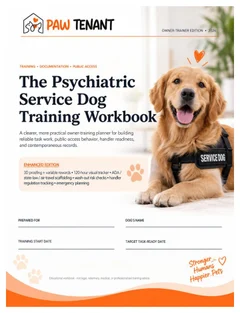
Start with what the dog would actually do
Some pet dogs can learn service work. Whether your dog is a good candidate depends on what you need the dog to do, its health and behavior, and how it handles the settings where you would rely on it. A dog that settles beside you at home might be a wonderful companion and still struggle to work in a busy hallway. A dog that enjoys meeting strangers might need more help ignoring them when you need its attention. Observe your own dog and talk with qualified professionals before spending money on equipment, programs, or paperwork.
Describe one disability-related action you would want the dog to learn. Under the U.S. Department of Justice's ADA guidance, a service dog is individually trained to do work or perform tasks for a person with a disability, and the task must relate directly to the disability. The dog's presence alone providing comfort does not meet that task standard. If you are still comparing the roles, read PawTenant's guide to service dogs and its comparison of service animals and ESAs.
Define the task before evaluating temperament
Write a plain description of the situation, the action you would want the dog to take, and how you would know the action helped. For example, retrieving a particular item on a trained cue is observable. “Make me feel better wherever we go” is too broad to tell a trainer what the dog would learn or how to evaluate progress. Talk through potential tasks with people who understand your functional needs and the limits of what a dog can safely learn. If the proposed action could put you or the dog at risk, discuss alternatives before attempting it.
Think about where you need the help. A task performed in a familiar room may place different demands on the dog than the same task in a loud or crowded place. Note the surfaces, travel, waiting time, and distractions you encounter on a normal day. Consider whether the dog can have breaks, rest, and an appropriate place to relieve itself. A potential task should fit your real routine and the dog's physical ability, not a scenario that exists only in a video demonstration.
Observe the pet you live with today
Take notes during ordinary activities in places where your pet is already welcome. Watch how the dog responds when a cart passes, another dog approaches at a distance, or a visitor arrives. Notice what happens after the distraction has passed. Can the dog turn back toward you, continue walking, or settle again? Record what you saw rather than guessing what it meant. “Barked when a bicycle passed and could not resume walking for several minutes” gives a trainer more information than “bad with bikes.”
Keep the observation low pressure and stop if the dog is distressed. Do not deliberately expose the dog to crowds, traffic, or other situations it finds overwhelming to see what happens. Keep a safe distance and talk with a qualified trainer about concerns. Share the full history, including incidents involving fear, snapping, guarding, or difficulty recovering from a surprise. A short session on a good day is one piece of information. The patterns you see over time will help a professional advise you about a realistic next step.
Ask your veterinarian and trainer different questions
At a veterinary visit, describe the physical demands you have in mind and any changes in your dog's behavior, stamina, or comfort. Ask whether there is any reason to avoid an activity or investigate a concern before training. A veterinarian can help you think through your individual dog's health. Take specific examples rather than asking for a blanket statement that the dog is ready. Share your actual travel or activity plans so the conversation reflects the work you are considering.
Ask a qualified trainer about their experience assessing candidate dogs, teaching the type of task involved, and recognizing when to slow down or stop. Ask what they observe during an assessment, how they plan to keep sessions manageable, and what progress would look like over several sessions. Ask whether they will provide a written training plan and how they handle fees if the work turns out to be unsuitable. Ask what would lead the trainer to recommend stopping. It is easier to plan a fallback before you have invested substantial time or started relying on the dog for a task.
Plan for training and handling over time
The DOJ says people with disabilities can train their own service dogs under the ADA. Some handlers work with a trainer for specific skills or use a program when that better fits their needs. Before choosing an approach, estimate who will practice with the dog, how often you can realistically train, and where training can occur. A reliable home routine may take less travel than regular sessions elsewhere, but both require time and consistent handling. Discuss who will care for the dog if you are unable to train or travel for a period.
The federal ADA public-access rules discussed in the DOJ FAQ do not cover service dogs in training. State or local rules may address access during training. Check the actual setting before taking a pet into a place that ordinarily excludes pets. For a dog that has completed relevant training, the DOJ also explains requirements around control and housebreaking in covered public settings. For flights, check DOT guidance and the airline's instructions separately. Review access rules for the setting where you need the dog.
Understand what documentation can and cannot do
A registration number, online certificate, or vest cannot train a dog or create ADA service-dog status. The DOJ explains that purchased certification or registration documents do not convey rights under the ADA. If you are considering an evaluation for your own documentation needs, PawTenant's PSD letter guide describes its evaluation pathway, and the PSD pricing page explains the service options. These resources concern documentation for people. Questions about training and suitability belong with professionals who can assess the individual dog.
If someone advertises a package that promises status after you pay, ask what the seller actually provides and whether it includes individualized training. Ask for its scope, fees, cancellation terms, and limits in writing. A document used in one setting also may not answer the requirements of another. For example, the DOT describes airline service-animal forms that carriers may require in covered circumstances. A letter from a clinician does not replace trained task performance or guarantee that a particular flight will accept the dog.
Decide what to do after the assessment
If the dog appears comfortable with the proposed work, agree on a small, observable training goal and a time to review progress. If the dog struggles, ask whether changing the training environment, addressing a health concern, or choosing a different support strategy makes more sense. Continuing to care for a dog as a pet can be the right outcome. Keep the animal's welfare and your need for dependable assistance in view when deciding how long to keep trying.
Can a dog that already comforts you start training? It may be possible to discuss training a specific action with a qualified professional, and the dog's existing behavior can give that person a starting point. Does breed tell you whether a dog will succeed? Breed alone cannot show how your dog handles the actual work. Can you start with paperwork? Start by identifying the task, observing your dog, and getting advice on suitability. If the proposed work is not a good fit, ask about alternatives before paying for further training.
Sources & further reading
General educational information, not individual medical or legal advice. Sources reviewed 2026-11-12.