


PawTenant
Scenery in california

California ESA Laws: Your Rights, Housing Protections, and ESA Letter Requirements

California residents may be able to live with an emotional support animal (ESA) even when their rental property has a no-pet policy. Understanding California ESA laws can help tenants learn how housing accommodations work, what documentation may be needed, and how to request an exception from a landlord.

Start Your ESA Assessment
  • All 50 StatesState-matched licensed care
  • Licensed Clinical ReviewIndependent eligibility decision
  • Verifiable LetterProvider and license details included
  • 24-Hour DeliveryAfter clinical approval

Trusted care. Verifiable documentation.

  • Licensed CliniciansEvaluations completed by professionals licensed in your state
  • Secure and Private ProcessHIPAA-conscious handling of your health information
  • Independent Letter VerificationHousing providers confirm the letter without seeing your health details

Both California fair housing protections and the federal Fair Housing Act (FHA) may protect eligible residents who need an emotional support animal because of a disability. However, an ESA letter does not automatically guarantee approval in every situation. The request must meet applicable legal requirements, and housing providers may consider specific exceptions allowed by law.

If you are exploring your options, PawTenant can help you understand the process of obtaining an ESA letter in California through a clinical evaluation. You can also read our guide to how to get an ESA letter online for an overview of the application process.

California ESA Laws

California has state-level rules that apply to certain emotional support animal documentation, alongside federal housing protections.

To Be Protected in California:

  • AB 468 requirements: For documentation concerning an emotional support dog, California law generally requires a healthcare practitioner to establish a client-provider relationship for at least 30 days before providing the documentation, complete a clinical evaluation, and meet applicable licensing and disclosure requirements.
  • Provider information: Relevant documentation must include required professional license details, including the license number, jurisdiction, type, and effective date.
  • Housing protections: Eligible tenants may request a reasonable accommodation for an ESA under California fair housing law and the federal Fair Housing Act.
  • No pet fees for approved accommodations: Housing providers generally cannot charge pet rent, pet deposits, or additional pet fees for an approved assistance animal accommodation. Tenants may still be responsible for damage caused by the animal.
  • Misrepresentation penalties: California law imposes penalties for certain fraudulent claims involving service dogs. ESA documentation and service-dog claims are not interchangeable.

AB 468 does not eliminate existing housing protections for people with disabilities. Its requirements concerning emotional support dogs should not be confused with the separate rules that apply to housing accommodations. Read more in our guide to ESA housing rights.

California legal requirements can depend on the circumstances and the type of documentation involved. For additional context, see the California Civil Rights Department's explanation of emotional support animals and fair housing law.

Get started: Get an ESA Letter

Woman with a dog in an apartment

Advantages of Having an Emotional Support Animal for California Residents

An emotional support animal can provide meaningful companionship and support for someone experiencing the effects of a mental or emotional health condition. For eligible California residents, housing protections can also help make it possible to live with an animal that supports their well-being.

Extra Housing Protections

California's fair housing laws work alongside federal protections to help eligible residents request reasonable accommodations. Depending on the circumstances, a housing provider may need to make an exception to a no-pet policy so a tenant can live with an assistance animal.

No Pet Fees for Approved Accommodations

When an ESA is approved as a reasonable accommodation, landlords generally cannot charge pet rent or pet deposits simply because the animal lives in the rental home. This can make a difference for residents who otherwise face strict pet policies or additional monthly costs. Tenants remain responsible for damage beyond ordinary wear and tear when applicable.

Mental Health Support

An ESA may provide comfort, companionship, and emotional support related to a person's disability. The need for an animal should be considered through an appropriate clinical or disability-related assessment when required. There is no universal ESA registration or certificate that independently establishes eligibility for housing protections.

Learn more about the process and documentation in our guide to getting an ESA letter.

Get started: Get an ESA Letter

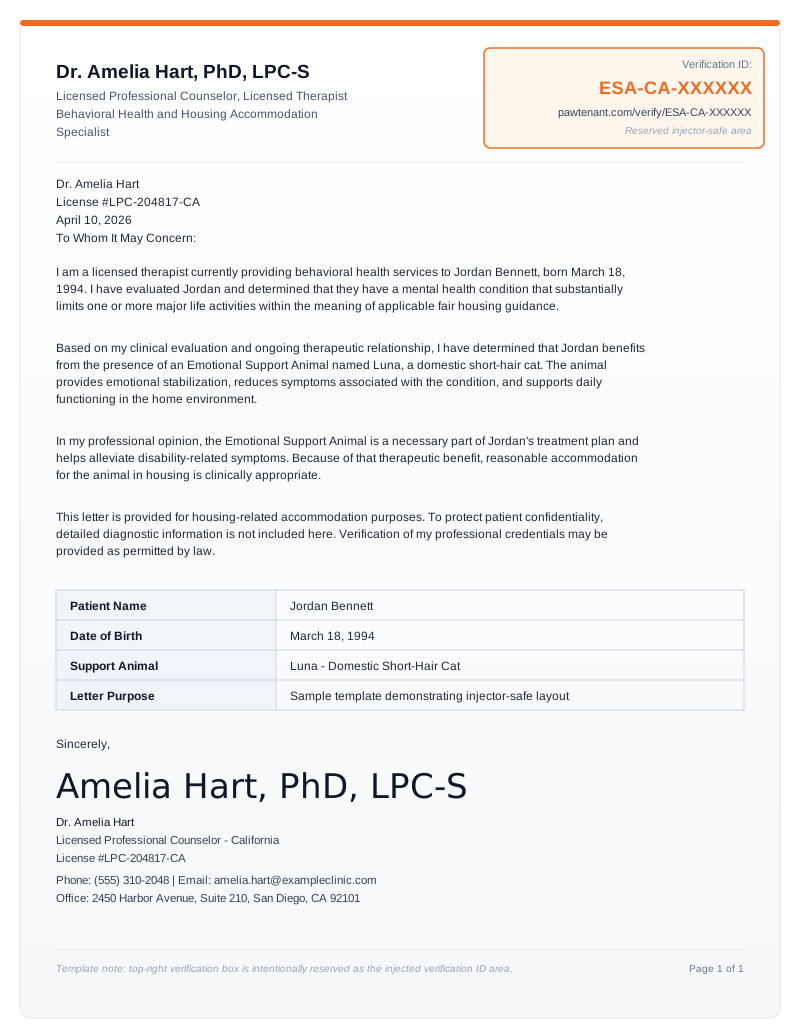
A Snapshot of Your California ESA Letter

When you submit an accommodation request to a landlord or property manager, your documentation should help establish the relevant professional's qualifications and the disability-related need for the animal when supporting information is necessary.

PawTenant's process is designed to help eligible residents understand the documentation involved in a housing accommodation request.

Sample letter layout
Illustrative ESA letter layout with provider information and signature area
Illustrative sample. Your finalized documentation depends on the completed professional review.

Provider Verification

A letter may include relevant provider details and a verification reference, where provided through the service. Landlords should use legitimate verification methods to confirm the authenticity of documentation rather than relying on an online registration badge or an ESA certificate alone.

Provider's License

For documentation subject to California's applicable requirements, professional license information must meet the relevant legal standards. This helps identify the practitioner responsible for the evaluation and documentation.

Housing-Focused Documentation

A housing-related California ESA letter should address the applicable accommodation purpose. It may support a request to live with an assistance animal in a rental property, but it does not guarantee acceptance in every case.

Privacy-Safe Information

A landlord generally does not need unrestricted access to a tenant's complete medical records simply to assess an accommodation request. The information reasonably needed can depend on whether the disability and the need for the animal are apparent or already known.

For practical guidance, read the ESA letter for your landlord.

Experienced Professionals You Can Trust

ESA documentation should follow a genuine clinical review rather than relying on automatic approval or a purchased certificate. PawTenant's process is intended to connect eligible applicants with professionals for an assessment of their circumstances and needs.

A Support Team That Cares

Understanding California ESA letter requirements can feel confusing, especially when a landlord asks for documentation. Support throughout the application process can help you understand the steps involved and what to expect.

Family with a dog at home

Available Across the State

Whether you live in Los Angeles, San Diego, San Jose, Sacramento, or another California community, the relevant state requirements still matter. Applicants should confirm that the professional conducting their evaluation is appropriately licensed for their circumstances.

Honest and Lawful Process

A legitimate emotional support animal letter in California should be based on an appropriate assessment. No registration fee, ID card, vest, or certificate can replace the clinical review and supporting documentation required for a person's situation.

Digital Delivery

If your application is approved, your final documentation can be delivered digitally according to the service's process. Timing depends on the evaluation, provider requirements, and any applicable waiting period.

Ready to explore your options? Start your ESA letter process.

ESA Letter vs. Psychiatric Service Dog

PawTenant supports people exploring both emotional support animal documentation and psychiatric service dog evaluations. These services are different, and the right option depends on a person's disability-related needs, eligibility, and circumstances.

Emotional Support Animal (ESA)

  • Housing-focused protections: An eligible ESA may be covered by reasonable accommodation protections under the Fair Housing Act and applicable California law.
  • No specialized task training required for ESA status: An ESA provides emotional support related to a person's disability; it does not need to perform a specific trained task to qualify as an ESA for housing purposes.
  • Common household animals: Dogs and cats are common examples of assistance animals used for emotional support in housing, although the applicable rules and assessment can depend on the animal.
  • Professional documentation: Supporting information from a qualified healthcare professional may be needed when the disability-related need is not apparent or already known.

Psychiatric Service Dog (PSD)

  • Task-trained support: A psychiatric service dog is trained to perform specific tasks related to a person's disability.
  • Public-access rights: Qualifying service dogs may have public-access protections under the Americans with Disabilities Act (ADA), subject to its rules.
  • Individual eligibility: The person must meet the applicable disability-related requirements, and the dog must be trained to perform qualifying tasks.
  • Different documentation: An ESA letter does not turn a dog into a service animal. A PSD evaluation and service-dog training address different requirements.

If you are considering a task-trained dog, read our guide to psychiatric service dog evaluations to understand the distinction.

This page provides general information and is not legal advice.

Frequently Asked Questions

1. Is a 30-day relationship needed for an ESA letter in California?

For documentation concerning an emotional support dog that falls under AB 468, a healthcare practitioner generally must establish a client-provider relationship for at least 30 days before providing the documentation and complete a clinical evaluation. The law does not prescribe a specific number of appointments. The requirements and any applicable exceptions should be checked for the particular situation.

2. Can any therapist give an ESA letter in California?

No. The professional must be appropriately licensed and qualified for the services they provide, and the documentation must meet the applicable requirements. For an emotional support dog letter covered by AB 468, additional requirements apply, including the client-provider relationship and clinical evaluation.

3. Do ESA letters work for housing in California?

A valid, relevant ESA letter may support a reasonable accommodation request for housing. Under the FHA and California law, eligible residents may be protected from certain pet restrictions and related fees. The outcome depends on the individual circumstances and applicable legal requirements.

4. Are California landlords required to accept all ESAs?

No. Housing providers generally must consider qualifying accommodation requests, but the law has exceptions. For example, a request may be denied in certain circumstances involving a direct threat or significant property damage that cannot be adequately addressed through another reasonable accommodation.

5. Are there penalties for fake ESA letters in California?

Fraudulent documentation can create legal and housing problems. California also imposes penalties for specific forms of misrepresenting a dog as a guide, signal, or service dog. The precise consequences depend on the conduct involved and the applicable law.

6. Does my ESA letter need to be issued by a provider licensed in California?

The provider must meet the applicable licensing rules. For documentation concerning an emotional support dog under AB 468, the practitioner must be licensed in the jurisdiction where the documentation is provided and include the required license information. Applicants should confirm that their provider can legally serve them in California.

7. How do landlords in California verify an ESA letter?

A landlord may review relevant documentation and, where appropriate, seek confirmation of its authenticity or request reliable information supporting a disability-related need that is not apparent. Tenants can ask their provider about available verification methods. Verification should not require unnecessary disclosure of private clinical details.

8. How long does the ESA letter application process take in California?

The timing varies according to the provider's assessment and the applicant's circumstances. For documentation covered by AB 468, the 30-day client-provider relationship requirement is an important consideration. An online service cannot lawfully bypass applicable requirements by promising immediate approval.

9. What should a valid California ESA letter include?

The letter should be genuine, supported by an appropriate evaluation, and issued by a qualified professional. Documentation concerning an emotional support dog under AB 468 must include the professional license details required by law. Depending on the housing request, the documentation should provide relevant support for the disability-related need without unnecessarily disclosing sensitive medical information.

10. Can I renew my ESA letter for housing in California?

You can seek an updated assessment or documentation if your circumstances or housing needs change, or if updated information is requested. Whether a new letter is necessary depends on the situation; there is no universal rule that every ESA letter expires after a fixed period. If you need updated documentation, review our guide to renewing an ESA letter.

See the Full ESA Letter Application Process

Understanding the process can help you prepare for an assessment and a possible housing accommodation request.

  • Clinical review: Share relevant information about your circumstances and support needs.
  • Provider assessment: A qualified professional reviews whether an ESA is appropriate for your situation.
  • Documentation: If approved, the provider prepares the relevant letter in accordance with applicable requirements.
  • Housing request: Submit the documentation to your landlord or housing provider when requesting an accommodation.

Landlord Verification

If your finalized PawTenant documentation includes a verification ID, follow the verification instructions provided with your letter. Verification can help confirm that a document is authentic; it does not independently establish eligibility or guarantee a landlord's decision.

  • Provider information should be accurate and consistent with applicable licensing requirements.
  • Only share the information reasonably needed for your accommodation request.
  • Keep a copy of the documentation and any communication with your landlord.

Learn more: ESA letter for your landlord.

Also Serving Nearby States

PawTenant also provides information about ESA documentation for residents in nearby states. Requirements can vary by state, so review the guidance that applies to your location.

Book Your ESA Letter Consultation Today

Feel confident taking the next step with a process centered on professional evaluation and appropriate documentation.

If you believe an emotional support animal may help with a disability-related need, learn how the assessment works and whether you may qualify.

Helpful guides for the rest of your ESA letter process.

ESA Letter Pricing

Learn about the cost of a clinically reviewed letter, what the service includes, and what happens if you do not qualify after review.

Read more about ESA letter pricing

ESA Letter FAQs

Find answers to common questions about eligibility, housing accommodations, documentation, and the clinical review process.

Read the ESA letter FAQs

How to Get an ESA Letter Online

Understand the steps involved in applying online, from the initial assessment to a provider's decision.

Learn how to get an ESA letter online

ESA Letter for Your Landlord

Learn how to submit a housing accommodation request and what documentation may help support it.

Read the landlord guide

Landlord Denied Your ESA?

Explore possible next steps if your housing accommodation request has been denied and learn about relevant fair housing protections.

Read what to do after a denial

ESA Travel and Housing Support

Understand the difference between housing protections and travel rules, and learn what an ESA letter can and cannot do.

Explore ESA travel and housing support

California ESA Letter for Apartments

Learn how to approach an apartment accommodation request, including no-pet policies, pet fees, and communication with a leasing office.

For a task-trained psychiatric service dog, explore the psychiatric service dog evaluation guide.

Legal information on this page is provided for general educational purposes. Laws and their application can change, so consult a qualified legal professional for advice about a specific housing dispute.

Simple, Transparent Pricing

Choose the ESA Letter Plan That Fits You

One-time letters and annual plans — every option includes a licensed professional and our money-back guarantee. No hidden fees.

ESA Letter

For up to 2 pets

$129one-time
  • Licensed provider evaluation
  • Covers up to 2 animals on one letter
  • Signed, FHA-compliant ESA letter
  • Typically delivered within 24 hours
  • Verification ID in your customer portal
  • Landlord verification support
  • Full refund if you don't qualify
  • Free Pet Care Planner by PawTenant — downloadable immediately after payment
Start Your Evaluation
Most Popular

ESA Annual Plan

For up to 2 pets

$115first year
Renews at $100/year for 1 pet or $115/year for 2 pets, beginning in year two
  • Annual evaluation & updated documentation
  • Renewal reminders before your letter expires
  • Automatic yearly renewal — cancel anytime
  • Priority scheduling — no waitlist
  • Everything in the ESA Letter plan
  • Free Pet Care Planner by PawTenant — downloadable immediately after payment
Choose Annual

Three-Pet ESA Letter

For 3 pets

$149one-time · fixed total

Prefer annual for 3 pets? $135 first year, then $115/year.

  • Licensed provider evaluation
  • Covers up to 3 animals on one letter*
  • Signed, FHA-compliant ESA letter
  • Typically delivered within 24 hours
  • Verification ID in your customer portal
  • Landlord verification support
  • Full refund if you don't qualify
  • Free Pet Care Planner by PawTenant — downloadable immediately after payment
Start Three-Pet

*Multi-pet letters cover up to three animals on one letter where clinically appropriate. Annual plans renew automatically at the renewal price shown; cancel anytime from your account portal.

  • VISA
  • AMEX
  • DISCVER