Support for Housing Requests
A properly supported accommodation request may help an eligible resident live with an emotional support animal in covered rental housing, including some properties with no-pet policies.


Trusted care. Verifiable documentation.
 HIPAA Compliant

Florida residents seeking housing accommodations for an emotional support animal should understand both federal and state fair housing rules. A legitimate Florida ESA letter can support a request for reasonable accommodation when the person qualifies and the housing situation is covered by applicable law.
Florida also has laws addressing fraudulent emotional support animal documentation. A letter should be based on a genuine assessment, not simply purchased as a certificate or registration. There is no universal government ESA registry that automatically grants housing rights.
For Florida residents, the right documentation may help support a request to live with an eligible emotional support animal in housing that otherwise restricts pets. Housing providers generally cannot treat an assistance-animal request as an ordinary pet request when fair housing protections apply. However, exceptions and case-specific factors can affect the outcome.
A valid letter should identify the professional who evaluated the individual and include the relevant professional information required by applicable law. Depending on the provider's profession and Florida law, additional requirements may apply. Learn more about the process on our How to Get an ESA Letter Online page.
Important: An ESA letter does not guarantee approval in every housing situation. Eligibility, the provider's qualifications, the documentation, and the property's circumstances can all matter.
Florida ESA housing requests are primarily informed by the federal Fair Housing Act and the Florida Fair Housing Act. These laws may require covered housing providers to make reasonable accommodations for people with disabilities, including allowing an emotional support animal when the legal requirements are met.
When an accommodation is approved, a housing provider generally cannot charge ordinary pet rent or pet deposits for an assistance animal. Breed, size, or weight rules that apply to household pets do not automatically determine whether an assistance animal can be accommodated. A provider may still consider legally relevant factors, such as a specific animal's conduct or whether the accommodation would create a qualifying undue burden or direct threat.
Florida law also addresses fraudulent claims and documentation. Residents should avoid services that promise automatic approval without an appropriate evaluation. A legitimate ESA letter for housing should reflect an actual clinical determination and be used for a genuine accommodation request.
For more detail about preparing a housing request, visit ESA Letter for Your Landlord. You can also review our ESA Laws resource for broader information about emotional support animal rules.
PawTenant helps eligible Florida residents access an evaluation with a qualified professional. The process starts with providing information about your needs, followed by a clinical review to determine whether an ESA letter is appropriate.
If a provider determines that you qualify, your documentation can help support a housing accommodation request. Approval is not automatic, and completing an assessment does not guarantee that a letter will be issued.
Get an ESA Letter Now
Start your assessment through PawTenant.

A properly supported accommodation request may help an eligible resident live with an emotional support animal in covered rental housing, including some properties with no-pet policies.
When an assistance animal is approved as a reasonable accommodation under applicable fair housing law, a housing provider generally cannot charge pet fees or pet deposits for that animal. Residents remain responsible for damage charges when legally permitted and for other applicable housing obligations.
For some people, the companionship of an emotional support animal may be part of a broader mental health support plan. An ESA is not a substitute for professional care, and a clinician determines whether the person meets the relevant criteria for documentation.
A housing-focused ESA letter should provide relevant information without unnecessarily revealing private medical details.
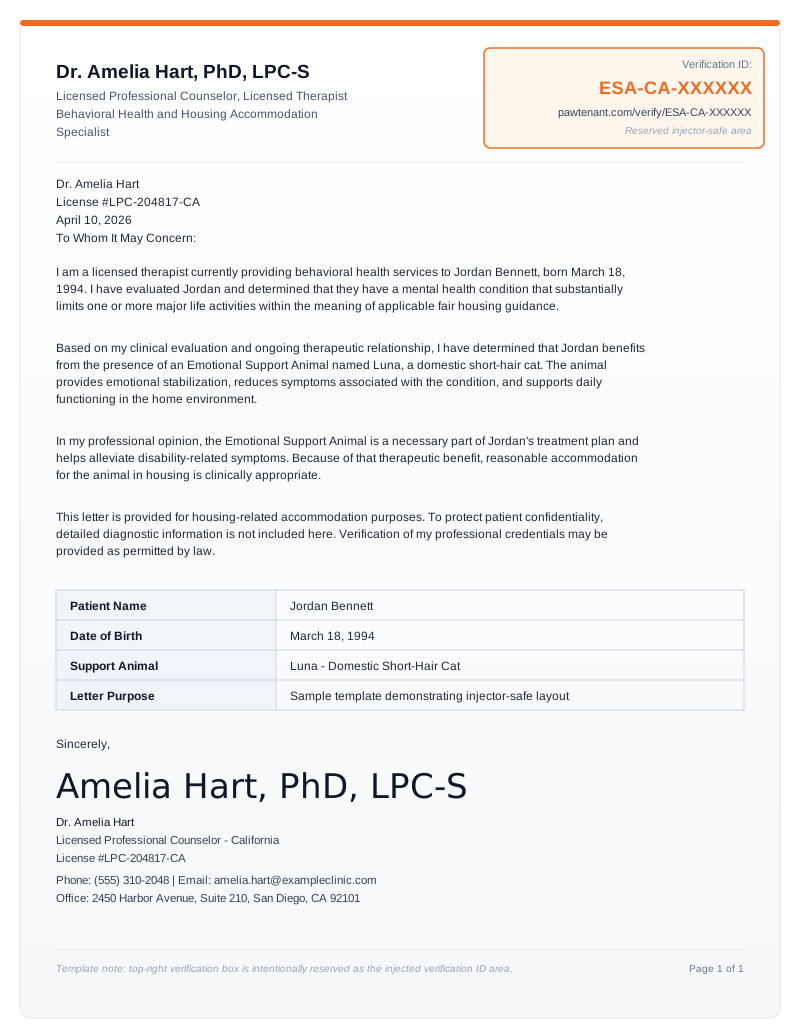
The letter identifies the professional who completed the assessment and includes applicable licensing details. Any license number or National Provider Identifier (NPI) should be accurate and verifiable where relevant.
The letter is intended to support an accommodation request, rather than serve as an animal registration certificate or proof of specialized service-dog training.
A landlord generally needs information sufficient to evaluate a qualifying accommodation request, not a detailed account of a person's diagnosis or therapy. The exact information that may be requested depends on the circumstances and applicable law.
If a PawTenant letter includes a portal verification ID, the landlord can use the designated verification page to confirm its authenticity. Verification confirms the document's authenticity only; it does not independently establish legal eligibility or guarantee housing approval.
PawTenant's process is designed to connect applicants with qualified professionals for an appropriate review. Whether a letter can be issued depends on the individual's circumstances and the provider's clinical determination.
Applicants can seek help understanding the steps involved, the information required, and how to use documentation when making a housing request.
Florida residents can begin the online assessment without needing to visit a physical PawTenant office. Provider availability and eligibility depend on the service and the applicant's circumstances.
PawTenant emphasizes clinical review rather than automatic certificates or registration claims. A letter should only be issued when the professional determines that the relevant requirements have been met.
If approved, the letter can be delivered digitally according to the service's process. Review the applicable terms and Refund Policy before placing an order.
Get an ESA Letter Now
Begin at PawTenant's ESA letter service.
PawTenant provides information about both emotional support animals and psychiatric service dogs. They are not the same, and their qualification standards, documentation, and legal protections differ.
An ESA letter does not make a dog a service animal, and an ESA does not automatically receive the public-access rights available to qualifying service dogs. Read Service Animal vs. ESA for a more detailed comparison, or visit the Psychiatric Service Dog Evaluation page.
This page provides general information, not legal advice.
Florida residents may be protected by the federal Fair Housing Act and the Florida Fair Housing Act when requesting a reasonable accommodation for an eligible emotional support animal in covered housing. Florida also has laws addressing fraudulent ESA documentation. The outcome depends on the circumstances and applicable requirements.
Telehealth may be an option when the professional is appropriately qualified and authorized to provide services in Florida and the evaluation meets applicable professional and legal requirements. An online questionnaire alone does not guarantee eligibility or a letter.
Florida law includes specific conditions for certain healthcare practitioners who provide emotional support animal documentation, including provisions related to an existing client-provider relationship in certain circumstances. The precise requirement can depend on the professional's license type and the applicable statute. Ask the provider how the rule applies to your situation.
A covered housing provider generally must consider a reasonable accommodation request when the person and animal qualify. However, not every request must be granted. Exceptions may apply, including certain property exemptions, insufficient supporting information, or legally relevant concerns about the specific animal or accommodation.
The professional must be appropriately qualified and authorized to provide the relevant services under applicable law. Florida has specific requirements for certain practitioners who provide ESA documentation. Confirm the provider's license type and authority to serve Florida residents before starting an assessment.
A landlord may review the documentation and, where permitted, request reliable information needed to evaluate the accommodation request. If your PawTenant letter includes a verification ID, use the designated PawTenant verification page. Verification should not expose unnecessary medical details.
Timing depends on the provider's availability, the information supplied, and whether further clinical review is needed. A letter is issued only if the provider determines that the applicant qualifies. No specific approval time can be guaranteed.
A letter should accurately identify the professional and include relevant credentials and licensing information required by applicable rules. It should support the person's disability-related need for an assistance animal without unnecessarily disclosing confidential clinical details. A generic certificate or animal registration alone does not establish a right to a housing accommodation.
You can seek a new assessment or updated documentation when appropriate. Whether an existing letter needs to be renewed depends on the document, the provider's guidance, changes in your circumstances, and the housing provider's lawful documentation needs. See Renew an ESA Letter for more information.
Explore the ESA Letter Application Process to understand the assessment, clinical review, and documentation steps.
When a finalized eligible PawTenant order includes a verification ID, landlords can enter it at pawtenant.com/verify to confirm document authenticity.
Verification confirms that a document is authentic; it does not replace the housing provider's legal review of the request.
Learn more about the process on our ESA Letter for Your Landlord page.
Letter Verification
Use the verification ID supplied with the finalized documentation.
No diagnosis or clinical answers displayed
Explore these related PawTenant resources for practical information about documentation and housing requests:
PawTenant offers online assessments in multiple states, subject to provider availability and eligibility. Explore state-specific information for nearby areas:
If you believe an emotional support animal may be part of your mental health support plan, begin by learning about the assessment process. PawTenant can help you understand the steps involved, but a letter is issued only when a qualified professional determines that you meet the relevant criteria.

ESA Letter Pricing
Learn about pricing, the clinical review process, and the applicable refund terms.
Read more

ESA Letter FAQs
Find answers about eligibility, housing documentation, and common ESA questions.
Read more

How to Get an ESA Letter Online
Review the steps from assessment to a qualified professional's decision.
Read more

ESA Letter for Your Landlord
Understand how to prepare a housing accommodation request and what documentation may be relevant.
Read more

Landlord Denied Your ESA?
Learn about possible next steps when a housing accommodation request is denied.
Read more

ESA Travel and Housing Support
Understand the difference between housing protections and rules for travel or other settings.
Read more

Florida ESA Letter for Apartments
Explore documentation and accommodation considerations for Florida apartment renters.
Read more
Have a task-trained psychiatric service dog? Read the Psychiatric Service Dog Evaluation guide to learn how PSD assessments differ from ESA documentation.
One-time letters and annual plans — every option includes a licensed professional and our money-back guarantee. No hidden fees.
For up to 2 pets
For up to 2 pets
For 3 pets
Prefer annual for 3 pets? $135 first year, then $115/year.
*Multi-pet letters cover up to three animals on one letter where clinically appropriate. Annual plans renew automatically at the renewal price shown; cancel anytime from your account portal.