Full Massachusetts ESA law overview
Learn more about ESA housing rights and ESA laws.


Federal FHA Protection · Massachusetts Housing Law · Licensed Provider Review · Privacy-Safe Verification · Refund if Not Approved
Start Your ESA AssessmentTrusted care. Verifiable documentation.
 HIPAA Compliant
The federal Fair Housing Act (FHA) and Massachusetts General Laws Chapter 151B may protect eligible residents who need an emotional support animal (ESA) as a disability-related housing accommodation.
An ESA letter in Massachusetts is documentation that may help support a housing accommodation request. It does not function as a pet registration or guarantee that every request will be approved.

Learn more about ESA housing rights and ESA laws.
Massachusetts Chapter 151B and the federal FHA provide housing-related protections for eligible people with disabilities who need an assistance animal. Whether a particular request qualifies depends on the circumstances, applicable law, and supporting information.
When an ESA accommodation is approved under applicable fair housing law, a housing provider generally cannot charge pet rent, pet fees, or an additional pet deposit for the assistance animal. Residents may still be responsible for actual damage caused by the animal.
An emotional support animal may provide comfort and emotional support as part of a person's broader mental health care. An ESA does not need specialized task training to provide emotional support, but the person must meet the relevant criteria for housing accommodation.
If you’re exploring eligibility, read how to get an ESA letter online to understand the evaluation process.
A housing-focused ESA letter should clearly identify the professional responsible for the documentation and provide relevant information supporting an accommodation request, while respecting the individual's privacy.
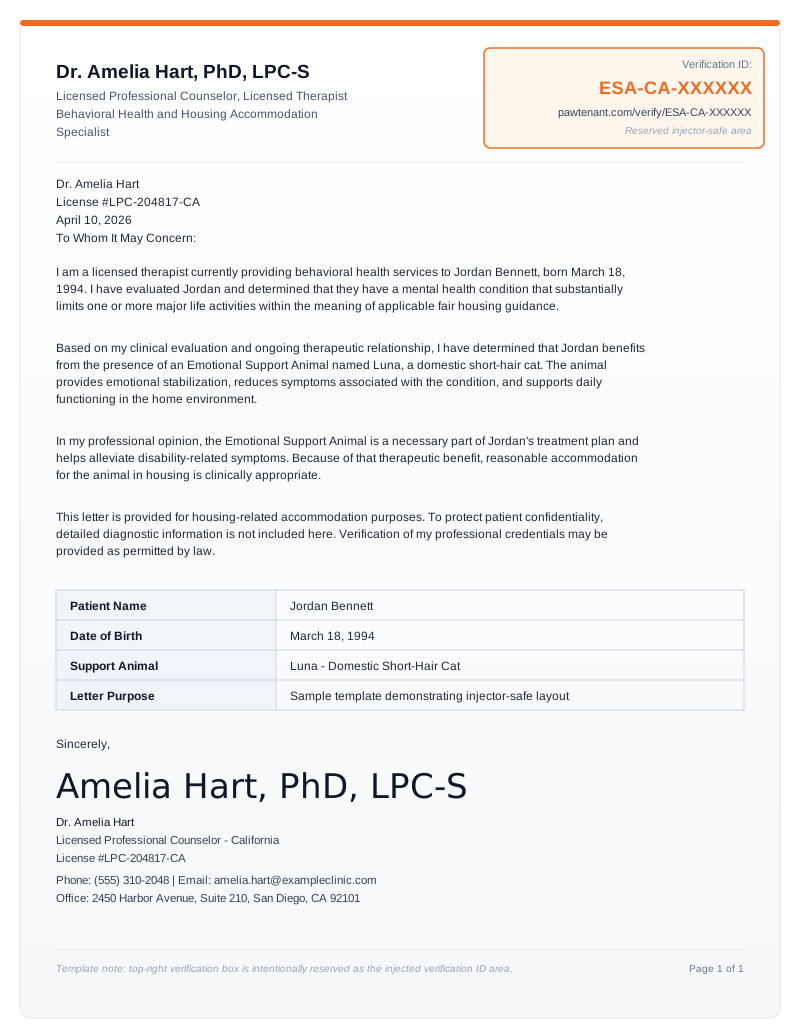
Eligible finalized orders may receive a unique verification ID in the customer portal. Landlords can use the PawTenant verification page to check the authenticity of supported documentation.
The letter may display the provider's name and relevant professional license details. The appropriate qualifications depend on the type of evaluation and applicable requirements.
Documentation is intended to support a housing accommodation request. It does not guarantee approval, replace a housing provider's lawful review, or create rights beyond those provided by applicable law.
A housing request generally should provide enough reliable information to establish the disability-related need without unnecessarily disclosing private medical details. A diagnosis does not ordinarily need to appear on the letter simply for a landlord to consider an accommodation request.
Read ESA letters for landlords for guidance on preparing and submitting a request.
PawTenant offers a process for people seeking an ESA letter in Massachusetts. Evaluations should be conducted by appropriately qualified professionals, and documentation should be issued only when supported by the provider's clinical assessment.
Questions can come up when arranging an evaluation or preparing a housing request. PawTenant aims to guide applicants through the process and explain the next steps, including what documentation is available after review.

Whether you live in Boston, Worcester, Springfield, Cambridge, Lowell, or another Massachusetts community, you can explore the online evaluation process without relying solely on in-person appointments. Availability and provider eligibility should be confirmed during the application process.
A legitimate Massachusetts ESA letter should be based on an appropriate evaluation rather than a simple purchase, registration, or automatic approval. Completing an online form alone does not establish eligibility, and no provider should promise a letter regardless of the assessment outcome.
If your evaluation is approved and the letter is finalized, digital delivery can make it easier to access your documentation. Processing times depend on the evaluation and any follow-up needed.
PawTenant supports both ESA and psychiatric service dog (PSD) evaluation pathways. They are not interchangeable: eligibility, training expectations, documentation, and legal access rights differ.
A PSD may be appropriate for someone who needs a dog trained to perform disability-related tasks. Eligibility and training needs should be considered individually. This page provides general information, not legal advice.
Learn more about service animals vs. ESAs or explore the psychiatric service dog evaluation process.
Massachusetts residents may have housing protections under the federal Fair Housing Act and Massachusetts General Laws Chapter 151B. These laws may require reasonable accommodation for an eligible person with a disability who needs an assistance animal. The exact protections depend on the housing arrangement and applicable exceptions.
A telehealth evaluation may be appropriate when the professional is properly qualified, authorized to provide services in the relevant circumstances, and able to conduct an adequate assessment. An online form or instant letter without a meaningful evaluation should not be treated as equivalent to a clinical review.
An HOA or other housing association may need to consider a reasonable accommodation request under applicable fair housing laws. The outcome depends on the property, governing law, and facts of the request. Housing providers may assess legitimate, legally recognized exceptions, but a blanket no-pet rule does not automatically settle an ESA request.
Ask the landlord for the reason for the denial and keep copies of your request and related communications. Review whether the accommodation was properly considered and whether the landlord identified a lawful reason for refusing it. You can read what to do if a landlord denies an ESA for possible next steps.
The relevant professional must be qualified and appropriately authorized to provide the evaluation. Whether a Massachusetts license is required can depend on the provider's profession, where the provider is located, the services delivered, and applicable licensing rules. Confirm the provider's credentials and authorization before proceeding.
A landlord may review the documentation and, when available, use the provider's contact details or verification system to confirm authenticity. Verification should not require unnecessary disclosure of private medical information. PawTenant customers with eligible finalized orders can use the PawTenant verification page to check supported documentation.
The timing varies based on appointment availability, the information provided, and whether further assessment is needed. Digital delivery may be available after a provider completes the evaluation and approves the documentation. Avoid relying on any service that guarantees approval before a proper review.
A housing-focused letter should contain enough information to support the disability-related need for an assistance animal and identify the professional responsible for the documentation. Relevant provider credentials and contact or verification details may also be included. A diagnosis and detailed treatment notes are generally not necessary simply to communicate an accommodation need.
You can seek a follow-up evaluation if your circumstances change, your documentation is outdated, or your housing provider reasonably requests updated information permitted by law. There is no universal rule that every ESA letter automatically expires after a fixed period. Check your document's details and the specific requirements that apply to your housing request. For guidance, visit and renew an ESA letter.
Start by completing the initial assessment, then follow the instructions for any consultation or clinical review. A qualified professional will determine whether the available information supports issuing an ESA letter.
Eligible finalized Massachusetts ESA orders receive a verification ID in the customer portal. Landlords can use pawtenant.com/verify to confirm the authenticity of supported documentation.
Verification confirms authenticity only. It does not independently determine legal eligibility or require a housing provider to approve a request that does not meet applicable standards.
Letter Verification
Use the verification ID supplied with the finalized documentation.
No diagnosis or clinical answers displayed
PawTenant provides ESA evaluation services across the United States, subject to provider availability and applicable requirements. If you live near the Massachusetts border, explore the relevant state page for information specific to your location.
Feel confident taking the next step with a clear, evaluation-based process. If you need an emotional support animal for a housing-related disability accommodation, start by learning about the assessment and documentation requirements.
Helpful guides for the rest of your ESA letter process.
Review pricing information for an ESA evaluation and learn about the applicable refund policy if you do not qualify after review.
Find answers to common questions about ESA letters, housing rights, eligibility, and clinical review.
How to Get an ESA Letter Online
Understand the steps from an initial assessment to a licensed provider's review and documentation.
Learn how to prepare a housing accommodation request and what information to share with your landlord.
Review possible next steps if your accommodation request is refused.
Explore how an ESA may provide emotional support and understand the limits of ESA documentation for travel and housing.
Have a task-trained psychiatric service dog? Read the psychiatric service dog evaluation guide.
One-time letters and annual plans — every option includes a licensed professional and our money-back guarantee. No hidden fees.
For up to 2 pets
For up to 2 pets
For 3 pets
Prefer annual for 3 pets? $135 first year, then $115/year.
*Multi-pet letters cover up to three animals on one letter where clinically appropriate. Annual plans renew automatically at the renewal price shown; cancel anytime from your account portal.