Cost Savings
When an assistance animal accommodation is approved, housing providers generally cannot charge pet fees or pet deposits for that animal. Residents may still be responsible for damage-related costs or other charges allowed by law.


Trusted care. Verifiable documentation.
 HIPAA Compliant
Federal Fair Housing Act (FHA) protections may apply to eligible residents with an emotional support animal (ESA) in West Virginia.

Understanding West Virginia ESA laws can help you prepare for a housing accommodation request. The federal Fair Housing Act is the main source of housing protections for eligible people who need an emotional support animal because of a disability-related need. State and local rules may also be relevant depending on the circumstances.
An ESA is not automatically approved simply because it provides comfort or companionship. Residents should understand the applicable requirements and obtain appropriate documentation before making a housing request.
An ESA in West Virginia may provide emotional support to a person experiencing a qualifying mental or emotional health condition. Dogs and cats are common emotional support animals, but the suitability of an animal depends on the individual’s needs and the circumstances.
An ESA is different from a pet registered through an online registry. There is no universal federal ESA registration or certificate that independently grants housing rights. Instead, housing accommodation requests are assessed under applicable law, with supporting documentation considered when permitted or necessary.
For more details, read our guide to ESA laws and learn how to get an ESA letter online.
Housing Security
Eligible residents can request reasonable accommodation for an ESA under the Fair Housing Act. Approval depends on the circumstances, applicable legal requirements, and whether the request is reasonable.

When an assistance animal accommodation is approved, housing providers generally cannot charge pet fees or pet deposits for that animal. Residents may still be responsible for damage-related costs or other charges allowed by law.
An emotional support animal may offer comfort, companionship, and emotional support as part of a person’s broader mental health care. The benefits vary by individual, and an ESA is not a replacement for professional treatment when treatment is needed.
A housing-focused ESA letter in West Virginia should provide relevant information supporting an accommodation request while respecting the resident’s privacy.
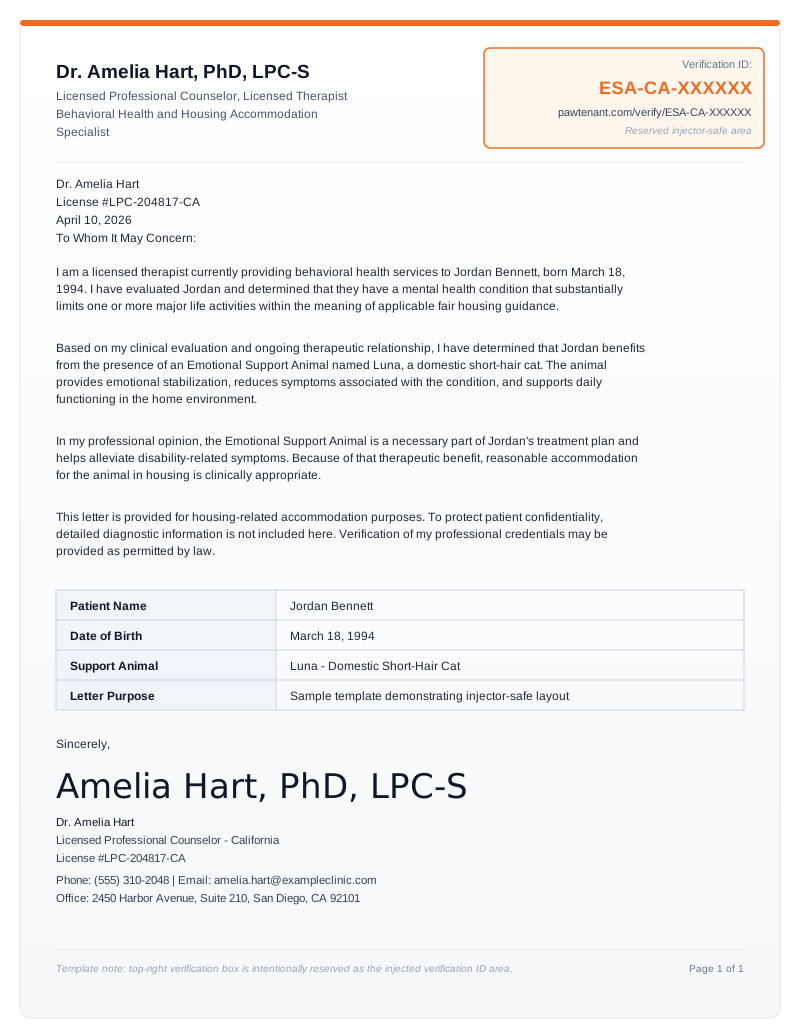
Eligible finalized PawTenant orders include a verification ID in the customer portal. Landlords can use it at pawtenant.com/verify to confirm the document’s authenticity.
The letter identifies the issuing professional and relevant credentials or license details, as applicable to the provider and document.
Documentation is prepared to support a housing accommodation request under applicable fair housing rules. A letter does not guarantee that every request will be approved.
A landlord generally does not need a tenant’s complete medical records or detailed diagnosis to evaluate an ESA request. The information required depends on the circumstances and applicable law.
PawTenant provides access to professionals who review ESA requests. When you apply, the appropriate provider assesses your circumstances and determines whether documentation is warranted. A letter is issued only when the relevant review supports it.
From starting your application to understanding your documentation, support is available to help explain the process and answer questions along the way.
Residents throughout West Virginia can explore PawTenant’s online process without needing to travel to a physical office solely to begin an application. Provider availability and professional eligibility depend on the individual case.
A legitimate West Virginia ESA letter should follow an appropriate professional review. PawTenant’s process is intended to support clinical assessment rather than provide automatic approval, instant certification, or a substitute for an individualized evaluation.
If your request is approved and your letter is finalized, it can be delivered digitally. Processing times depend on the assessment, provider availability, and whether additional information is needed.
PawTenant supports both ESA and psychiatric service dog (PSD) evaluations. They are different options, and their qualification criteria, training requirements, and legal protections are not interchangeable.
A PSD may be appropriate for someone who needs a dog trained to perform disability-related tasks. The right option depends on individual circumstances, eligibility, and the relevant legal requirements.
Learn more about service animals vs. ESAs, or explore the psychiatric service dog evaluation.
This page provides general information, not legal advice.
West Virginia residents may rely on federal Fair Housing Act protections when requesting an ESA accommodation. Whether a request qualifies depends on the circumstances and applicable requirements. Other state or local rules may also apply.
A telehealth evaluation may be appropriate when it complies with applicable professional licensing requirements and standards of care. The provider must be qualified to evaluate the person in their jurisdiction, and the assessment should be individualized rather than an automatic approval.
The timeline depends on provider availability, the information supplied, and the review process. If approved, the finalized letter may be delivered digitally. Applying online does not guarantee same-day approval.
A housing provider may deny a request in certain circumstances allowed by law, such as when a legally recognized exception applies or the request would create an undue burden or fundamental alteration. A landlord should not reject a qualifying request solely because of a no-pet policy. See our guide to what to do if a landlord denies your ESA.
The provider must meet the professional licensing rules that apply to the service and the resident’s location. The appropriate requirements can depend on the provider’s profession and whether the evaluation is conducted remotely. Confirm that the professional is authorized to provide the service in your circumstances.
A landlord may review relevant documentation when permitted by fair housing rules. PawTenant customers with an eligible finalized order can use the verification ID in their portal at pawtenant.com/verify to confirm authenticity. Verification does not disclose a diagnosis or replace the landlord’s lawful accommodation review.
The process varies depending on the completeness of the application and the provider’s review. Some applications may need follow-up information before a decision can be made. Allow enough time before a lease deadline or housing accommodation request.
A housing-related ESA letter should contain relevant information from an appropriately qualified professional supporting the disability-related need for an assistance animal. Provider identification and applicable professional credentials should be clear. A diagnosis or full medical history generally should not be necessary for a landlord to assess a request.
You can seek a renewed assessment or updated documentation if your circumstances, housing situation, or documentation needs change. There is no single federal expiration date that automatically applies to every ESA letter, but a housing provider may have a lawful reason to request updated reliable information in some circumstances. Review our guide to renewing an ESA letter.
See the complete guide to the ESA letter application process, from starting your application to receiving documentation after professional review.
Eligible finalized West Virginia ESA orders include a verification ID in the customer portal. Landlords can enter the ID at pawtenant.com/verify to confirm the document’s authenticity.
Verification confirms the document’s authenticity; it does not guarantee that a landlord must approve every accommodation request.
Letter Verification
Use the verification ID supplied with the finalized documentation.
No diagnosis or clinical answers displayed
PawTenant offers ESA letter services in multiple states. If you live near West Virginia’s borders, explore the relevant state page for information suited to your location.
Get clear information about the assessment process and whether an ESA letter may be appropriate for your situation.
Helpful guides for the rest of your ESA letter process.
Understand the costs associated with a professionally reviewed ESA letter and review the applicable refund policy.
Find answers to common questions about ESA documentation, housing rights, eligibility, and professional review.
Learn about the application process, professional assessment, and what happens if your request is approved.
Understand how to submit an accommodation request and what documentation may be relevant to your landlord.
Explore potential next steps if a housing provider denies your request.
Understand the differences between housing accommodations and travel rules, and what an ESA letter can and cannot do.
Have a task-trained psychiatric service dog? Read the psychiatric service dog evaluation guide.
One-time letters and annual plans — every option includes a licensed professional and our money-back guarantee. No hidden fees.
For up to 2 pets
For up to 2 pets
For 3 pets
Prefer annual for 3 pets? $135 first year, then $115/year.
*Multi-pet letters cover up to three animals on one letter where clinically appropriate. Annual plans renew automatically at the renewal price shown; cancel anytime from your account portal.