
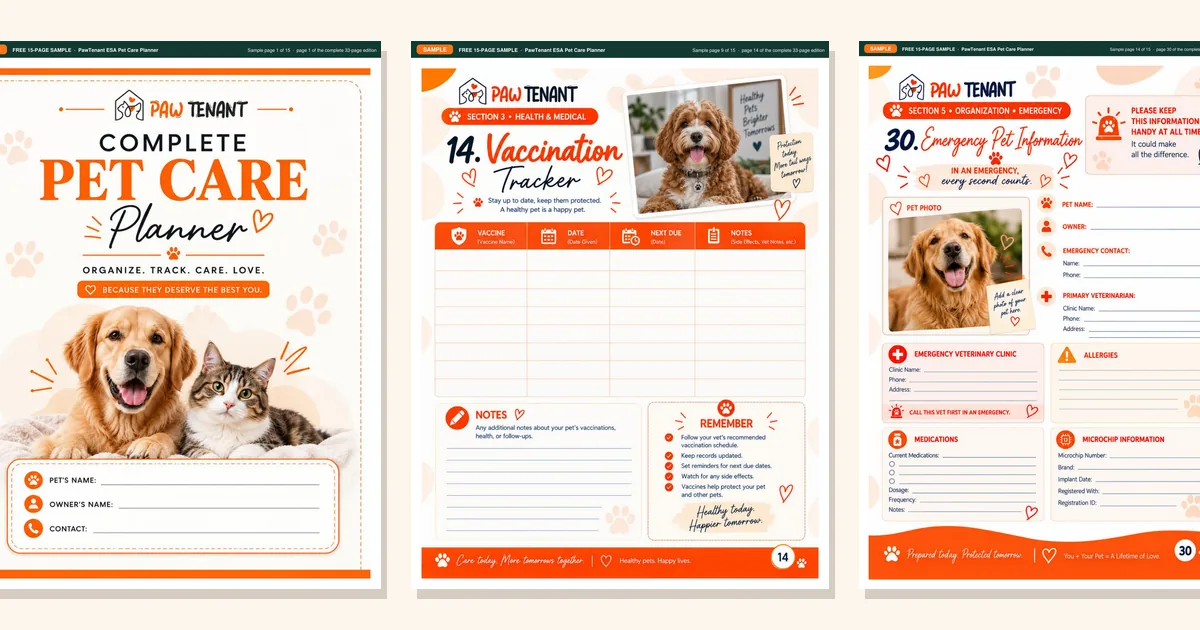
Living with an emotional support animal or a psychiatric service dog means keeping track of a lot. When those details live in a phone, a folder and your memory, something gets missed. The planner gives every record a page, and it works for dogs, cats and other companion animals.
Enter your email address below and we will send you the free 15-page sample as a PDF. If you handle a psychiatric service dog, you can choose our PSD Training Workbook sample instead.
Free 15-page sample
Get a free 15-page sample PDF
Choose the sample that fits you and we will email it to you as a printable PDF.
These are samples. The complete editions are included with eligible PawTenant ESA or PSD letter orders.
What Is in the Free 15-Page Sample
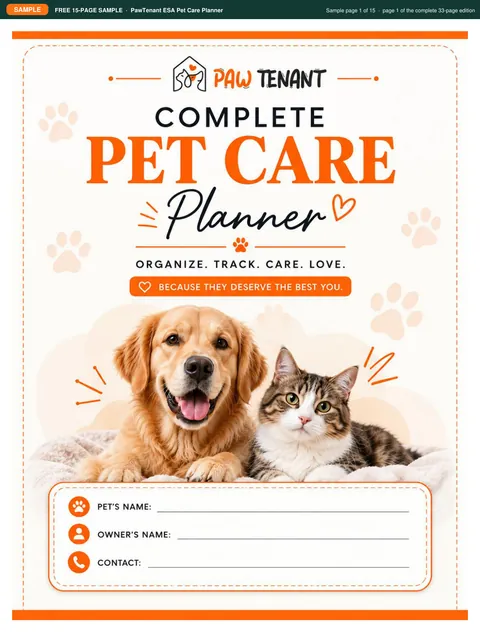
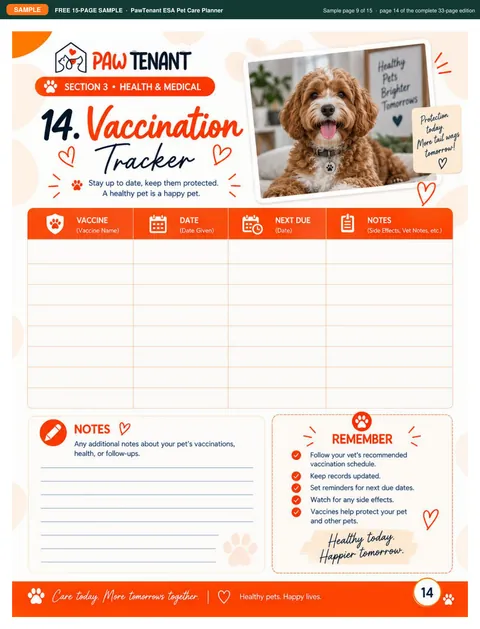
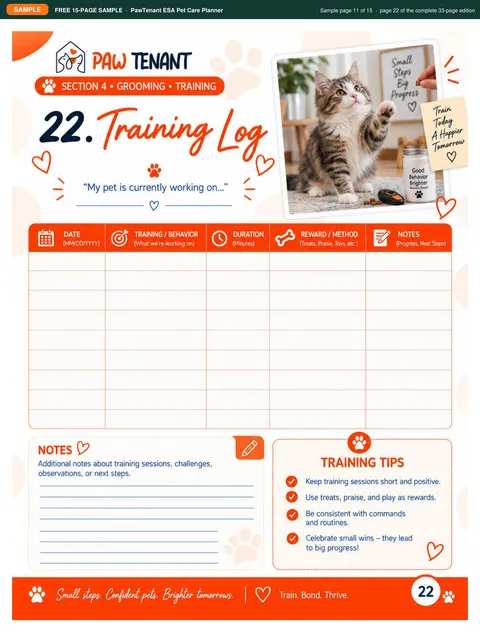
The sample is 15 pages taken from the complete planner, each marked as a sample page. You receive:
- The cover and the contents of the complete planner
- A quick-start page explaining how the planner works
- My Pet at a Glance: profile, microchip and owner contact details
- A daily care checklist and a feeding schedule
- A health and wellness tracker and a vet information page
- A vaccination tracker and a medication tracker
- A training log and a behavior tracker
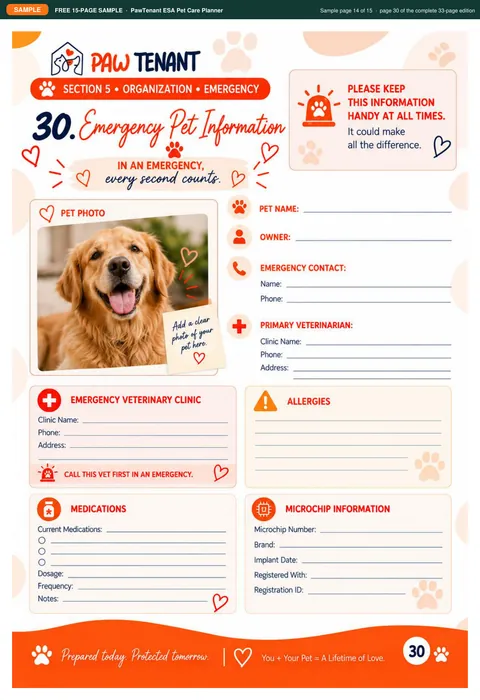
- A pet calendar and an emergency pet information page
- The closing page with the planner's personal-organization notice
What the Complete Planner Adds
The complete Pet Care Planner has 33 pages across five sections: My Pet, Daily Care, Health and Medical, Grooming and Training, and Organization and Emergency. Beyond the sample pages it adds a personality and favorites page, a routine planner, a food and treat tracker, emergency vet details, a medical history, a medication refill tracker, allergy and weight records, grooming pages, training goals, a progress page, important dates, a supplies inventory, a shopping list, an expense tracker, an emergency checklist and a notes page.
The complete planner is included with eligible PawTenant ESA letter orders. The free sample is yours to keep and print either way.
Who the Planner Is For
- ESA owners who want vaccination, licensing and vet details ready when a landlord or property manager asks.
- Psychiatric service dog handlers who want a dated record of training, behavior and progress.
- New adopters building a routine for feeding, exercise, grooming and vet care from day one.
- Caregivers and pet sitters who need clear instructions when someone else looks after your animal.
- Multi-pet households that print a separate set of pages for each animal.
Why Organized Records Matter for ESA and PSD Owners
Housing requests
Housing providers commonly ask every animal owner for routine records such as rabies vaccination and local licensing. When your dates are in one place, those requests take minutes. For how landlords review the letter itself, see what happens after you submit an ESA letter.
Training records
Under the Americans with Disabilities Act (ADA), a service animal is a dog individually trained to do work or perform tasks for a person with a disability, and the tasks must be directly related to that disability. HUD's current housing enforcement policy also turns on training (see how HUD's approach changed in 2025–2026). No law requires a training log, and a log does not replace actual training, but a dated log helps you and your trainer see progress.
Emergencies and travel
If you are hospitalized, evacuated or delayed away from home, a caregiver needs your animal's medications, allergies, vet and microchip details at a glance. The emergency pages are built for exactly that.
A written daily routine is also simply easier to keep. If routines matter for your own mental health, talk with your provider about how your animal fits into your plan.
ESA vs. Psychiatric Service Dog: What Is the Difference in 2026?
The two terms are often confused, and the difference matters more since HUD changed its enforcement approach in 2025–2026. Here is a plain-language comparison.
| Topic | Emotional support animal (ESA) | Psychiatric service dog (PSD) |
|---|---|---|
| Definition | An animal whose presence provides comfort or support. No task training is required. | A dog individually trained to do work or perform tasks directly related to a psychiatric disability. |
| Public places | No ADA public-access rights (for example stores and restaurants). Some state laws differ. | Covered by the ADA. When the need is not obvious, staff may ask only two questions and may not demand documentation. |
| Housing | Requests can still be made under the Fair Housing Act and state law, but since May 2026 HUD's own enforcement focuses on trained animals, so state law and documentation matter more. | HUD's May 2026 enforcement policy centers on individually trained animals like these. |
| Documentation | A letter from a licensed provider who evaluated you is the usual supporting document for a housing request. | The ADA and the U.S. Department of Transportation do not require a PSD letter. A landlord may ask for reliable information when your need is not obvious. |
| Air travel | Airlines are not required to treat ESAs as service animals and may treat them as pets. | Airlines must treat psychiatric service dogs like other service dogs and may require the DOT service animal form. |
Registries, ID cards and vests do not create legal status for either type of animal.
How to Use the Planner With a Housing Request
- 1Complete the pet profile and vet pages. Add your animal's details, microchip number and your vet's contact information.
- 2Record vaccinations and licensing. Enter the dates in the vaccination tracker and keep copies of the certificates behind it.
- 3File your documentation with the planner. If you have a letter from your provider, keep a copy in the same binder so it is easy to find.
- 4Log training if your dog performs tasks. Note the tasks, dates and progress in the training log.
- 5Review monthly. Update the calendar so renewals and vaccine due dates never lapse.
Records Worth Keeping in One Binder
Behind the planner pages, keep the paperwork that proves the dates you wrote down:
- Vaccination certificates, especially rabies, which landlords and municipalities often ask about.
- Local license or registration. City or county animal licenses apply to all owners, not just assistance-animal handlers.
- Microchip registration, confirming your contact details are current.
- Vet visit summaries covering checkups, medications and anything your vet has noted.
- Your provider's letter or your dog's task-training notes, if you have them.
- A recent photo, which helps if your animal is ever lost.
Keep your own medical records out of this binder. A housing provider may ask for reliable information about your disability-related need for the animal, but not for your medical history, treatment notes or diagnosis.
Do You Need an ESA Letter or PSD Letter?
A planner keeps your records in order, but it cannot establish that you have a disability-related need for an animal. Only a licensed professional can assess that. If you are considering an ESA letter for housing, a licensed provider evaluates your situation and decides whether an emotional support animal is clinically appropriate. Approval is never guaranteed.
Several states now regulate when a provider may write ESA documentation, for example by requiring an established client relationship first. A PSD letter is not required for ADA public access or for flying, though some people use one to support a housing request. PawTenant connects you with licensed providers; learn how it works on how to get an ESA letter and how to get a PSD letter.
A 10-Minute Weekly Routine
The planner works best when you spend a few minutes on it at the same time each week:
- Review the daily care checklist and note anything you missed.
- Check food, litter and medication levels and reorder before you run out.
- Update the calendar with upcoming vet visits, grooming and vaccine due dates.
- Write down one highlight from the week in the behavior tracker or notes.
Printing and Setup Tips
The pages are close to 8.3 by 10.6 inches, so choose “fit to page” when printing on standard letter paper. Print double-sided for a lighter binder, punch three holes, and keep the pages you update most, such as the vaccination and medication trackers, at the front. Print extra copies of the daily checklist, feeding schedule and training log whenever you run out.
Handling a psychiatric service dog? The free PSD Training Workbook sample focuses on task training and public-access practice.