
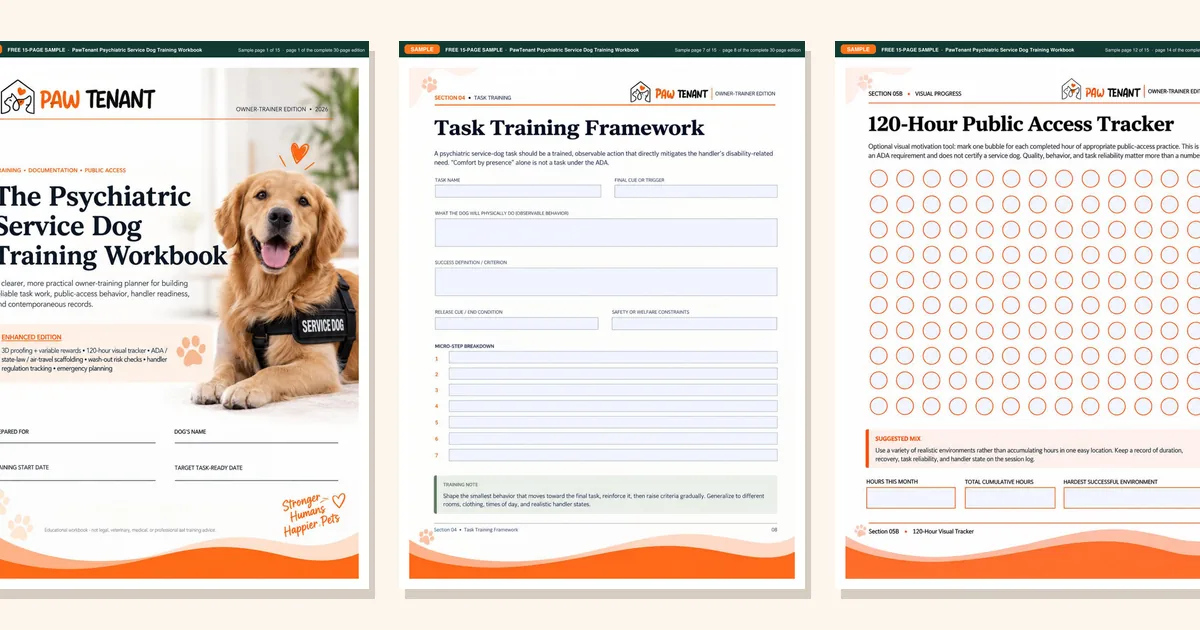
This article vs. the free 15-page sample
This article is free to read and explains how psychiatric service dogs are defined, trained and documented. The free sample is a separate 15-page PDF, emailed to you when you ask for it below. It contains 15 of the 30 pages of the complete workbook, each marked as a sample page.
The complete 30-page workbook is included with eligible PawTenant PSD letter orders. Neither the sample nor the complete workbook certifies a dog or creates legal rights.
Free 15-page sample
Get the free PSD Training Workbook sample
Enter your email and we will send you a free 15-page sample of the PawTenant Psychiatric Service Dog Training Workbook as a printable PDF.
- 15 printable pages from the 30-page workbook
- Task training framework and a worked example
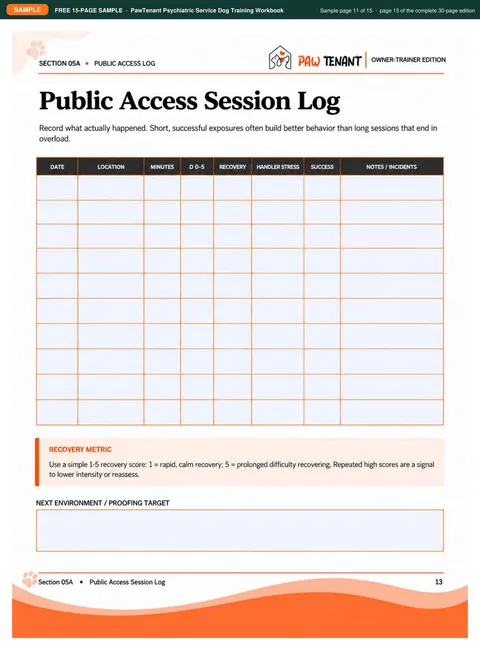
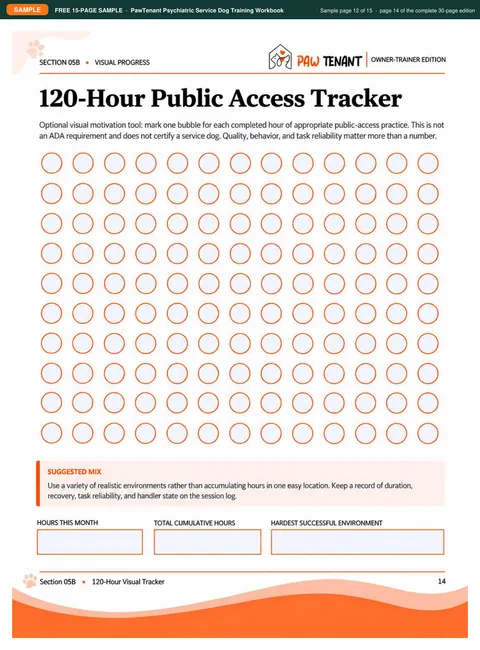
- Public access session log and the optional 120-hour tracker
This is a sample. It does not certify a dog. The complete workbook is included with eligible PawTenant PSD letter orders.
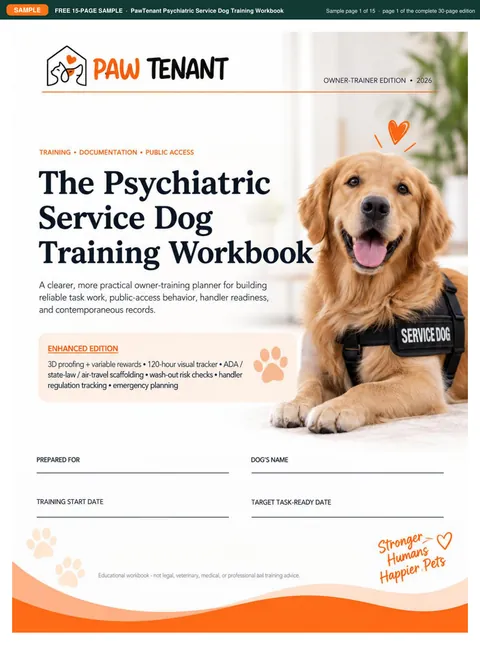
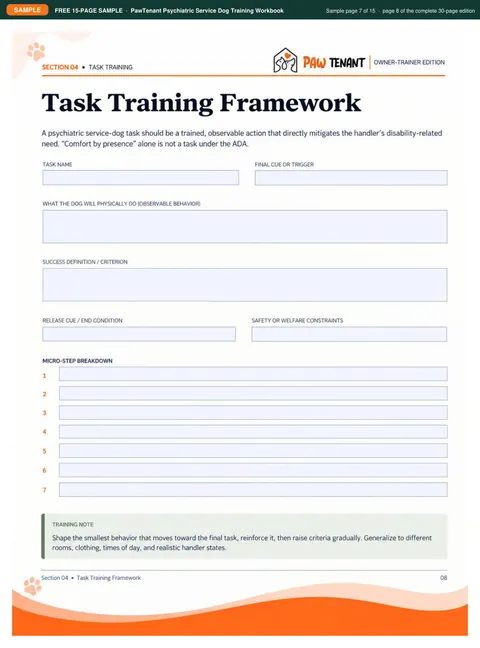
What Is in the Free 15-Page Sample
The sample follows the way a training plan actually unfolds. You receive:
- The cover and a how-to-use page with the contents of the complete workbook
- A dog and handler profile
- A pre-training foundation checklist and the wash-out red flags page
- A core obedience master tracker
- The task training framework, a worked deep pressure therapy example and a detailed task log
- Public access foundations, a public access session log and the optional 120-hour tracker
- An ADA public access quick reference
- A weekly training log
- Legal and training references, with the workbook's scope notice
The complete workbook adds pages such as a 3D obedience session log, a panic alert example, an access denial log, a state law worksheet, an air travel readiness page, handler preparation and regulation logs, a milestone checklist, an emergency and backup plan, a veterinary summary, a go-bag checklist and monthly reviews.
What Makes a Dog a Psychiatric Service Dog Under Federal Law?
Under the Americans with Disabilities Act (ADA), a service animal is a dog individually trained to do work or perform tasks for a person with a disability, and the work or tasks must be directly related to that disability. For a psychiatric service dog, that could mean a dog trained to recognize the start of an anxiety attack and take a specific action to help. A dog whose presence only provides comfort does not qualify, which is the line between a psychiatric service dog and an emotional support animal.
A few rules surprise new handlers. You may train your dog yourself; the ADA does not require a professional program. Service dogs do not have to wear a vest, ID tag or special harness. When the need is not obvious, staff may ask only two questions: whether the dog is required because of a disability, and what work or task it has been trained to perform. Staff may not ask for documentation, ask the dog to demonstrate the task, or ask about your disability.
Housing and air travel follow separate rules. HUD's May 2026 enforcement memorandum focuses its Fair Housing Act enforcement on animals individually trained to do work or perform tasks (see how HUD's approach changed). For flights, U.S. Department of Transportation rules require airlines to treat psychiatric service dogs like other service dogs, and airlines may require the DOT Service Animal Air Transportation Form, on which you attest to your dog's health, behavior and training. Accurate records help you complete it truthfully.
| Topic | Psychiatric service dog (PSD) | Emotional support animal (ESA) |
|---|---|---|
| Training | Individually trained to do work or perform tasks related to the handler's disability. | No task training required. |
| Public places | Covered by the ADA. Only two questions may be asked. | No ADA public-access rights. |
| Housing | HUD's May 2026 enforcement policy centers on individually trained animals. | Requests can still be made, but HUD's own enforcement no longer focuses on untrained animals; state law and documentation matter more. |
| Air travel | Treated like other service dogs. The DOT form may be required. | Airlines may treat as pets. |
| Letter required? | Not by the ADA or DOT rules for public access or flights. | A provider's letter is the usual supporting document for housing requests. |
If you are also weighing an ESA, read what happens after you submit an ESA letter for housing.
Do You Need a PSD Letter?
Not to take your dog into a store, restaurant or other public place. The ADA does not require a letter, certification or registration, and DOT rules no longer require a mental health professional's letter for a psychiatric service dog on a flight. Online registries, certificates and ID cards do not create legal rights, and the U.S. Department of Justice does not recognize them as proof that a dog is a service animal.
A letter from a licensed provider can still be useful in some settings, such as a housing request where your disability-related need is not obvious. It can support your need for a dog. It cannot certify your dog's training; your dog's trained tasks and behavior are what count. Misrepresenting a pet as a service dog can carry penalties in several states; in California, for example, knowingly and fraudulently claiming to be the owner or trainer of a service dog is a misdemeanor (Penal Code §365.7).
Are 120 Training Hours Required?
No. The ADA sets no minimum number of training hours. The “120 hours” figure you may see online comes from the International Association of Assistance Dog Partners (IAADP), whose minimum training standards call for at least 120 hours over six months or more, including at least 30 hours of public outings. It is a private standard, widely cited, not a legal requirement.
That is why the workbook's 120-hour tracker is optional, and the page says so. Quality matters more than a number: reliable tasks, calm behavior and good recovery after startling events are what make a dog ready.
How to Train and Document a Task in Six Steps
- 1Confirm suitability. Complete the pre-training foundation checklist with your veterinarian. Review the wash-out red flags, such as persistent fear, aggression or pain, and change course if they appear.
- 2Define two to four tasks. Describe each task in observable terms: the cue, what the dog physically does, and when it ends.
- 3Build and proof obedience. Raise only one of the three Ds at a time (distraction, duration, distance) and log each session.
- 4Shape the task in small steps. Use the task framework to break the behavior down, reinforce each step, and record progress in the detailed task log.
- 5Practice public access gradually. Keep outings short and successful, and log your dog's recovery time and your own stress after each one.
- 6Review monthly. Decide what to maintain, advance, simplify or pause, and keep your emergency plan current.
Why Records Made at the Time Matter
A note written when something happens is more useful than a memory reconstructed months later. Good notes help in a few practical ways:
- Answering the two questions. Clear task descriptions make it easier to explain what your dog is trained to do without disclosing your diagnosis.
- Completing travel forms honestly. The DOT form asks you to attest to training, and a dated history supports an accurate answer.
- Preserving facts after an access challenge. Record the date, place, the exact words used and any witnesses, without drawing legal conclusions on the spot.
- Spotting patterns. Tracking your own energy and stress alongside your dog's can explain why a familiar skill suddenly falls apart. If tracking your stress raises concerns, share it with your provider.
A log does not create legal rights and does not replace actual training. It is a tool for honest self-assessment.
Dogs in Training, State Laws and Air Travel
Dogs that are still in training are not service animals under the federal ADA, although some state and local laws give them access rights, often with conditions. Because those rules vary and change, check your state's law before training in public places.
For flights, airlines may require the DOT Service Animal Air Transportation Form, may ask for it up to 48 hours before departure when you booked earlier than that, and may require a separate relief attestation form for flights of eight hours or more. An airline may still refuse a dog whose behavior poses a direct threat or that is not under control. Always confirm current rules with the airline before you fly.
Who the Workbook Is For
- Owner-trainers who have a disability and are training their own dog with guidance from a trainer and veterinarian.
- Handlers working with a professional trainer who want their own organized record of sessions and progress.
- People still deciding whether a service dog, an ESA or neither is the right fit; the readiness and wash-out pages are designed for honest reflection.
It is not a shortcut. Not every dog is suited to service work, and a workbook cannot replace qualified professional help when behavior or welfare concerns arise.
Talking With a Licensed Provider
Whether you have a disability-related need for an assistance animal is a clinical question that only a licensed professional can answer. PawTenant connects you with licensed providers who can evaluate your situation and, if it is clinically appropriate, provide documentation. They cannot train or certify your dog or guarantee any outcome, and a PSD letter is not needed for public access. Some states regulate how and when providers may issue documentation, so availability and timing vary. See how to get a PSD letter.
Looking for everyday records instead? The free Pet Care Planner sample covers vaccinations, medications and daily care.