State & Federal Coverage
Wisconsin's Open Housing Law and applicable federal fair housing protections can support reasonable accommodation requests for eligible residents with an ESA.


Federal FHA-Protected
Wisconsin Open Housing Law
Licensed Provider Review
Wisconsin-Specific Guidance
Refund If Not Approved
Trusted care. Verifiable documentation.
 HIPAA Compliant
Federal fair housing protections and Wisconsin's Open Housing Law may protect eligible residents who need an emotional support animal in housing.
An ESA letter in Wisconsin should document the need for an emotional support animal following an appropriate evaluation by a qualified professional. PawTenant connects residents with professionals licensed in their state who review each assessment individually.

Wisconsin residents can learn more about the accommodation process in our guide to ESA housing rights and our overview of ESA laws.
An emotional support animal in Wisconsin may provide comfort and support to someone living with a qualifying mental or emotional health condition. For eligible residents, housing accommodation rules can help make it possible to live with an ESA even when a property normally restricts pets.
An ESA is not the same as a pet registration or certification. A vest, ID card, or certificate alone does not establish a right to housing accommodation. The important step is an appropriate clinical evaluation and documentation that supports the person's disability-related need.
If you are considering an ESA, read our guide on how to get an ESA letter online to understand the process before beginning an assessment.
Wisconsin's Open Housing Law and applicable federal fair housing protections can support reasonable accommodation requests for eligible residents with an ESA.
When an animal qualifies as an assistance animal under applicable housing law, a housing provider generally cannot charge pet rent or a pet deposit simply because the resident has the animal. Residents may still be responsible for actual damage caused by the animal.
An ESA can provide emotional comfort and companionship as part of a person's broader mental health support. Whether an ESA is clinically appropriate depends on an individual assessment.
PawTenant's ESA documentation is designed to support housing accommodation requests in Wisconsin. When an evaluation results in approval, the letter includes relevant provider information and a way to verify the document's authenticity.
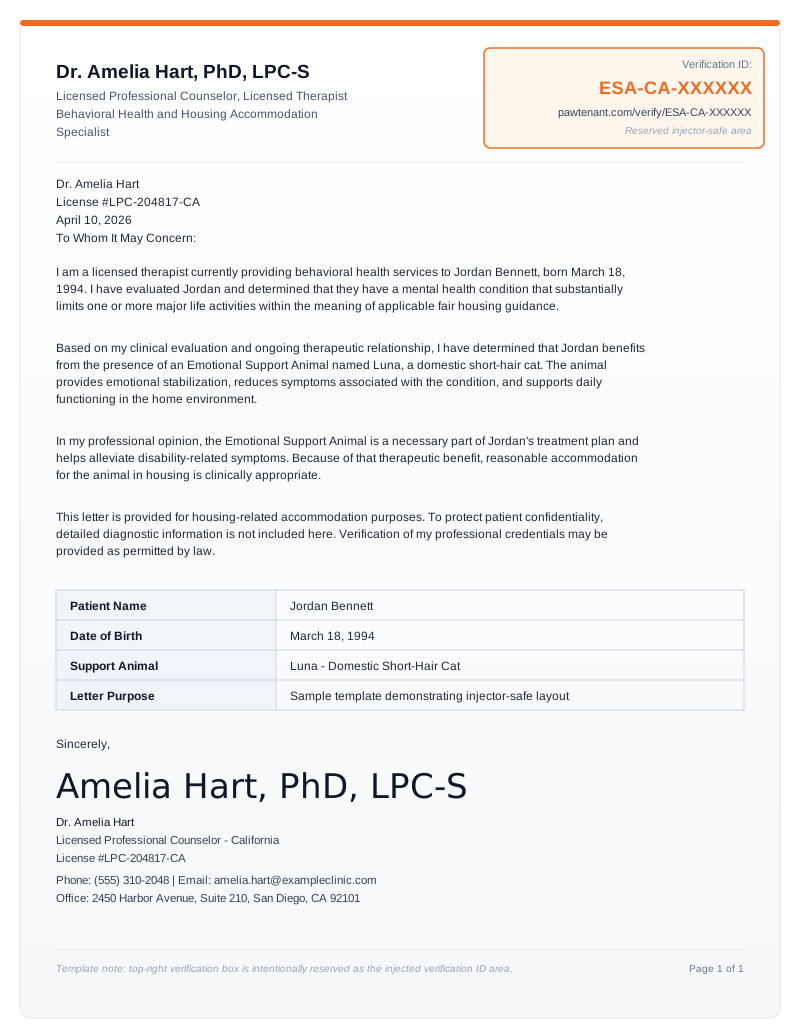
Eligible finalized letters include a unique verification ID that a housing provider can check at pawtenant.com/verify.
The letter includes the reviewing professional's name, credentials, license details, and NPI, as applicable.
Documentation is intended to support a reasonable accommodation request under applicable fair housing protections. A letter supports the request but does not guarantee approval in every situation.
Verification confirms the document's authenticity without displaying your diagnosis or confidential assessment answers to your landlord.
For more information about sharing documentation, see our guide to an ESA letter for your landlord.
PawTenant connects people with licensed mental health professionals who review ESA assessments individually. Your evaluation is matched to a professional licensed in your state, subject to provider availability.
Questions can come up when you are preparing a housing request. PawTenant's support team can help explain the assessment process, documentation, and verification steps. Visit our contact page if you need assistance.
Whether you live in Milwaukee, Madison, Green Bay, Kenosha, or another Wisconsin community, you can begin online. The assessment is reviewed by a professional licensed in your state when an appropriate provider is available.
An ESA letter should follow a genuine clinical review. Approval is not automatic, and a professional may determine that an ESA is not appropriate based on the information provided.
If the professional approves your assessment, your letter is typically delivered digitally after provider review. Timing can vary depending on the evaluation and any follow-up questions. If you do not qualify, PawTenant's stated refund policy applies.
PawTenant supports both emotional support animal evaluations and psychiatric service dog evaluations. These services are different, and each has its own eligibility and documentation considerations.
A PSD may be appropriate for someone who needs a dog trained to perform disability-related tasks. The right option depends on the person's needs and the applicable requirements. This page provides general information, not legal advice.
Yes. Wisconsin's Open Housing Law includes protections relating to assistance animals in housing, alongside applicable federal fair housing protections. Whether a specific request qualifies depends on the person's circumstances, the housing involved, and any applicable exceptions.
An online evaluation may be appropriate when it is conducted by a qualified professional licensed in Wisconsin and meets applicable requirements. A legitimate evaluation involves individual clinical review rather than automatic approval based only on a questionnaire.
Timing depends on the professional's review and whether follow-up information is needed. PawTenant states that approved letters are typically delivered within 24 hours after provider review, but this is not a guarantee of approval or a same-day result.
A landlord must consider a qualifying reasonable accommodation request, but some denials may be permitted under applicable law. Examples can include insufficient documentation where it is legitimately required, a direct threat that cannot be reduced, or a risk of substantial property damage supported by evidence. A blanket refusal based only on a no-pet policy may raise fair housing concerns.
PawTenant matches assessments to a professional licensed in the state where the resident lives, subject to availability. Using a state-licensed professional can help ensure the evaluation follows relevant state requirements.
A landlord can review the documentation and use the verification ID when one is provided. PawTenant's verification portal confirms the letter's authenticity and relevant provider details without displaying the resident's diagnosis or confidential assessment answers.
The online assessment takes about five minutes, according to PawTenant. The full process also includes the professional's review and any follow-up questions. If the assessment is approved, the letter is typically delivered within 24 hours after provider review.
A letter should identify the person and relevant accommodation need, include the professional's identifying and licensing details, and provide appropriate documentation of the recommendation. PawTenant letters also include verification information. A certificate or registration card alone does not replace an appropriate clinical evaluation.
You may need updated documentation if your existing letter is no longer current, your circumstances change, or your housing provider reasonably requests updated information. Follow your provider's guidance and check with your housing provider about its documentation process. See our page about renewing an ESA letter.
Getting started is straightforward: confirm your state, complete the confidential assessment, select your preferred package, and have your information reviewed by a licensed professional. A letter is issued only if the professional determines that it is appropriate.
Eligible finalized Wisconsin ESA orders include a verification ID that a housing provider can enter at pawtenant.com/verify.
Verification confirms authenticity; it does not guarantee that every housing request will be approved.
PawTenant provides ESA evaluation services in multiple states, subject to professional availability. If you live near Wisconsin's border, explore the relevant state guide:
Feel confident taking the next step toward understanding whether an emotional support animal may be appropriate for you. Start an assessment and have your information reviewed by a licensed professional.
Helpful guides for the rest of your ESA letter process.

ESA Letter Pricing
Understand the cost of a clinically reviewed ESA letter and the refund policy if you do not qualify.

ESA Letter FAQs
Find answers to common questions about ESA letters, housing rights, eligibility, and the evaluation process.

How to Get an ESA Letter Online
Explore the steps involved, from completing the assessment to receiving documentation if approved.

ESA Letter for Your Landlord
Learn how to submit documentation and make a housing accommodation request.

Landlord Denied Your ESA?
Understand possible next steps if your housing provider refuses your accommodation request.

ESA Travel & Housing Support
Learn about ESA support, housing considerations, and the limits of ESA documentation for travel.
Have a task-trained psychiatric service dog? Read the psychiatric service dog evaluation guide.
One-time letters and annual plans — every option includes a licensed professional and our money-back guarantee. No hidden fees.
For up to 2 pets
For up to 2 pets
For 3 pets
Prefer annual for 3 pets? $135 first year, then $115/year.
*Multi-pet letters cover up to three animals on one letter where clinically appropriate. Annual plans renew automatically at the renewal price shown; cancel anytime from your account portal.